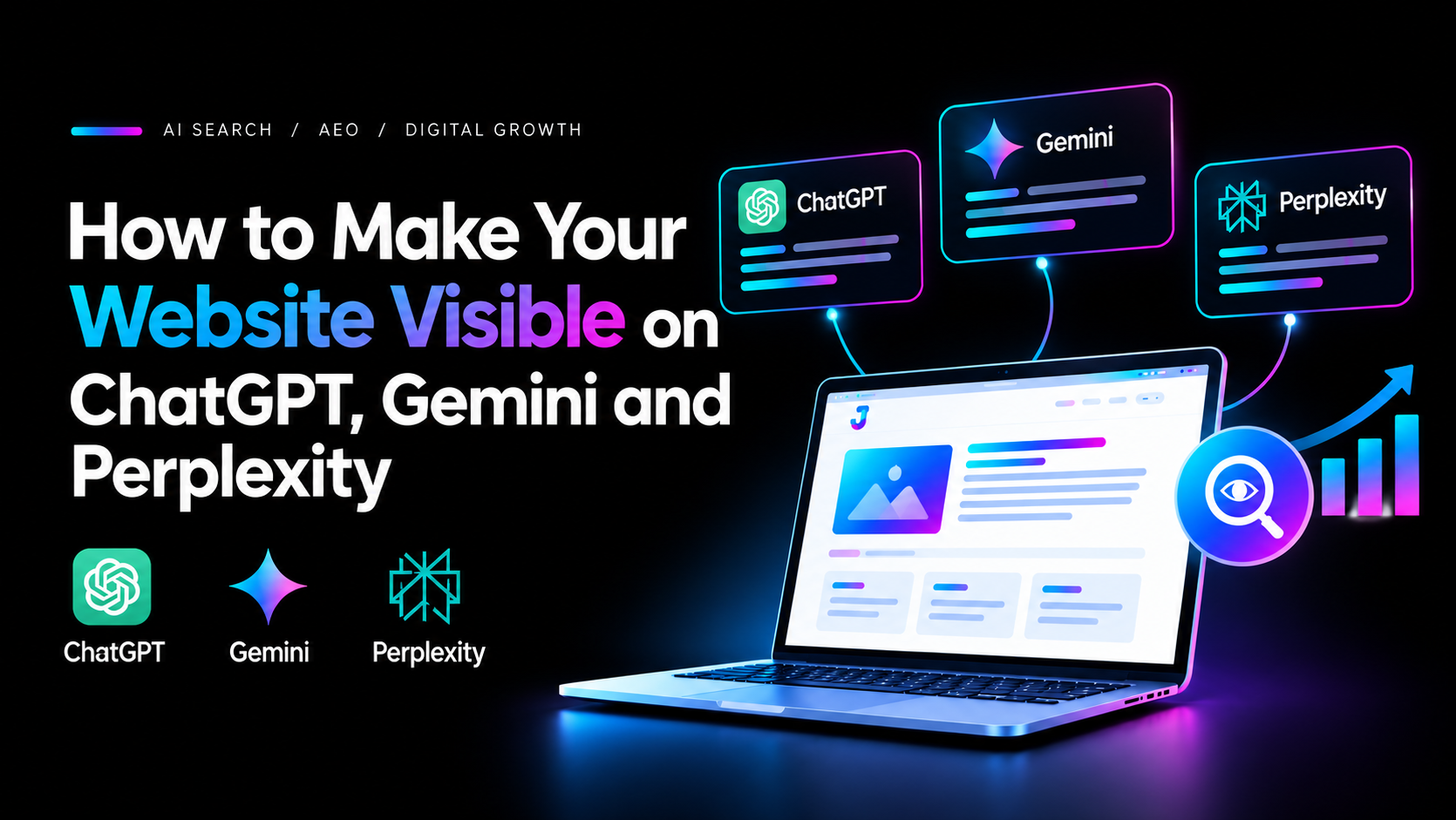
Search is changing. People no longer just “Google it” — they ask ChatGPT, Gemini, or Perplexity directly and expect a straight answer.
If your website isn’t optimized for these AI engines, you’re invisible to a fast-growing chunk of your audience.
This guide breaks down exactly how to fix that using AEO (Answer Engine Optimization) and GEO (Generative Engine Optimization) — the two frameworks built specifically for AI-driven search.
What Is AEO and GEO? (Quick Definitions)
- AEO (Answer Engine Optimization): Optimizing content so it gets picked as the direct answer to a user’s question — think featured snippets, but for AI chat responses.
- GEO (Generative Engine Optimization): Optimizing content so AI tools like ChatGPT and Gemini can understand, trust, and cite your website when generating answers.
In short:
- SEO = ranking on Google’s results page
- AEO = being the answer inside a chat response
- GEO = being cited as a source by generative AI
Why This Matters Right Now
- AI chatbots are becoming a primary research tool, especially for younger users
- Perplexity and ChatGPT search cite real websites as sources — visibility here drives real traffic
- Google’s own AI Overviews pull from the same kind of structured, trustworthy content
- Early movers get a visibility advantage before competition catches up
Step 1: Understand How AI Engines “Choose” Sources
AI models don’t rank pages the way Google does. Instead, they:
- Pull from indexed web content (via search partnerships or crawling)
- Prioritize clear, well-structured, factual content
- Favor pages that directly answer a specific question
- Trust sources with strong authority signals (reputation, citations, consistency)
- Prefer recent, updated content over stale pages
Key takeaway: Write for clarity and citation-worthiness, not just keywords.
Step 2: Structure Content Like an Answer, Not an Essay
AI tools extract answers easily when content is broken into scannable chunks.
Do this:
- Open sections with a direct answer in the first 1–2 sentences
- Use question-based subheadings (H2/H3)
- Keep paragraphs to 2–3 sentences max
- Use bullet points and numbered lists generously
- Add a clear TL;DR or summary box near the top
Avoid this:
- Long, unbroken paragraphs
- Burying the answer under backstory or fluff
- Clickbait intros that delay the point
Step 3: Optimize for Question-Based Queries
People ask AI tools questions in natural language. Your content should mirror that.
- Research real questions using:
- “People Also Ask” on Google
- Reddit and Quora threads
- AlsoAsked.com or AnswerThePublic
- ChatGPT/Perplexity’s own suggested follow-up questions
- Turn each question into an H2 or H3
- Answer it clearly within the first few lines under that heading
- Add an FAQ section at the end of every important page
Example structure:
H2: What is GEO in digital marketing?
[2-3 sentence direct answer]
[Supporting bullet points]
Step 4: Add Structured Data (Schema Markup)
Structured data helps AI systems and search engines understand your content’s meaning, not just its text.
Priority schema types to add:
- FAQ Schema – for question/answer sections
- Article Schema – for blog posts and guides
- HowTo Schema – for step-by-step content
- Organization Schema – for brand trust signals
- Author Schema – for E-E-A-T (experience, expertise, authority, trust)
This won’t guarantee citation, but it makes your content machine-readable — a core GEO requirement.
Step 5: Build Topical Authority
AI engines favor sites that appear knowledgeable across a whole subject, not just one lucky page.
- Create content clusters around core topics (pillar page + supporting articles)
- Interlink related pages internally
- Cover a topic in depth — definitions, comparisons, examples, FAQs
- Update older content regularly instead of only publishing new pages
Why it matters: A single well-optimized page rarely gets cited. A site that “owns” a topic does.
Step 6: Strengthen E-E-A-T Signals
AI models weigh trust signals heavily before citing a source.
- Show real author names and credentials on articles
- Add an “About Us” page with real team info
- Include original data, case studies, or first-hand insights
- Get mentioned or linked from reputable third-party sites
- Keep NAP (Name, Address, Phone) consistent for local businesses
Step 7: Make Content Easy for AI Crawlers to Access
Even great content fails if AI crawlers can’t reach it.
- Check robots.txt — make sure AI crawlers aren’t blocked (e.g., GPTBot, Google-Extended, PerplexityBot)
- Ensure fast page load speed
- Use clean, semantic HTML (proper H1/H2/H3 hierarchy)
- Submit an updated XML sitemap
- Avoid heavy JavaScript rendering that hides text content
Step 8: Get Cited and Mentioned Elsewhere
AI tools often trust content that’s already validated across the web.
- Get featured in industry roundups, guest posts, or interviews
- Encourage backlinks from niche-relevant, credible sites
- Maintain active, consistent branding across Reddit, LinkedIn, and Quora
- Answer questions on forums with links back to detailed resources
Step 9: Track Your AI Visibility
Traditional analytics won’t show you this — you need to check manually (for now).
- Search your target queries directly in ChatGPT, Gemini, and Perplexity
- Note whether your brand or content is mentioned or cited
- Track referral traffic from AI platforms in Google Analytics (look for chat.openai.com, perplexity.ai, gemini.google.com)
- Reassess and update content that isn’t showing up
Quick AEO + GEO Checklist
- Content answers a specific question in the first 2 sentences
- Short paragraphs and bullet-heavy formatting
- FAQ section included with schema markup
- Clear author bio and credentials
- Topic covered in-depth, with internal links to related content
- Fast-loading, crawlable, mobile-friendly page
- AI crawlers not blocked in robots.txt
- Backlinks or mentions from credible third-party sources
- Content updated within the last 6–12 months
Final Thoughts
Ranking on Google is no longer the finish line. Being the answer inside ChatGPT, Gemini, or Perplexity is the next visibility battleground.
The websites that win here will be the ones that write clearly, structure content for easy extraction, and build genuine authority — not the ones that keyword-stuff for old-school SEO.
Start with your highest-traffic pages, apply this framework, and track your presence in AI answers over the next few months.